Crescent-tail
Bigeye (Priacanthus hamrur): Bigeyes, also
called Goggleyes or Bullseyes are nocturnal. Hence the
especially large eyes to make the most of the dim light. During the
day they hang suspended off the reef face often with their mouths
open filtering-out the zooplankton and fish larva swept in by the
ocean currents. As daylight fades they start feeding on
bottom-dwelling invertebrates like crustaceans. Growing to 35 cm,
Bigeyes are mostly seen in their red livery but they can rapidly
change colour to plain silver, or when the mood takes them silver and
red bars.
white tip shark
Welcome!
Hi everyone,
Welcome to Snorkelling in the Maldives, a blog designed to enable any snorkeller or scuba diver, whether novice or experienced, to get maximum pleasure from a trip to the Maldives. Many posts will concern the easy identification of the fish you see there as well. The one above is a Whitetip Reef Shark, the most widespread shark species on the Maldivian Reefs.
Our snorkelling career started in Australia's Hayman Island 20 years ago. Since then we have been fascinated by the world beneath the waves. We have snorkelled in Lord Howe, Australia, and seen the southern-most reach of the soft corals. We have bobbed in Brampton and Heron Islands in the Australian Whitsundays on the Great Barrier Reef, swum round Michaelmas Key in Cairns, dived in Indonesia and the Gilli Islands, sampled the warm waters of the south seas in Vanuatu, Rarotonga, New Caledonia and Fiji and explored the reefs of the Maldives in the Indian Ocean. And never once did the underwater world lose its fascination. We are hooked on the Maldives and keep coming back - twice a year to atolls that seem to feature more exotic and rare fish than anywhere else.
Welcome to Snorkelling in the Maldives, a blog designed to enable any snorkeller or scuba diver, whether novice or experienced, to get maximum pleasure from a trip to the Maldives. Many posts will concern the easy identification of the fish you see there as well. The one above is a Whitetip Reef Shark, the most widespread shark species on the Maldivian Reefs.
Our snorkelling career started in Australia's Hayman Island 20 years ago. Since then we have been fascinated by the world beneath the waves. We have snorkelled in Lord Howe, Australia, and seen the southern-most reach of the soft corals. We have bobbed in Brampton and Heron Islands in the Australian Whitsundays on the Great Barrier Reef, swum round Michaelmas Key in Cairns, dived in Indonesia and the Gilli Islands, sampled the warm waters of the south seas in Vanuatu, Rarotonga, New Caledonia and Fiji and explored the reefs of the Maldives in the Indian Ocean. And never once did the underwater world lose its fascination. We are hooked on the Maldives and keep coming back - twice a year to atolls that seem to feature more exotic and rare fish than anywhere else.
Slideshow
Monday, December 10, 2012
Wednesday, November 21, 2012
Moon Wrasse:
(Thalassoma lunare) Very inquisitive towards snorkellers, the 22cm Moon Wrasse features a
body vertically-lined with incomplete red. It varies in colour from
dark green for the females to bright blue for the males and has pink
bands radiating from the eyes. The pectoral fins of the male often
feature bright colours.
Tuesday, November 13, 2012
Scribbled
Leatherjacket: (Aluteres scriptus) What a
wonderfully evocative name this member of the Filefish family has. It
is not at all common in the Maldives but you will know it if you are
lucky enough to see it. It averages 60 cm but can grow to a metre in
length – a third of which is its extremely long tail. It is
beautifully coloured in pale blue and yellow with plenty of black
spots. It has an extremely varied diet including hydrozoa, sea
anemones, gorgonias, tunicates and algae.
Sunday, November 4, 2012
Friday, November 2, 2012
Sergeant Major:
(Abudefduf vaigiensis) Named after the stripes it carries, the Sergeant Major, which can
grow up to 15 cm, is very common in the Maldives. It will form large
schools off the deep drop-off. Easily recognised by its four vertical
thick blue stripes on a silver body with yellow blotches in between
on the upper back. At spawning time the male prepares a nest on a
bare patch of hard bottom that the female fills with as many as
25,000 eggs. These hatch a week later.
Tuesday, October 30, 2012
Porcupine
Ray
(Urogymnus
asperrimus):
The strange-looking Porcupine Ray is not a resident of the Maldives
but is a frequent visitor. Covered with plate-like tenticles and
sharp thorns, it is also known as the Roughskin Stingaree,
Rough-skinned Ray, Solander’s Ray and Thorny Ray. The Porcupine Ray
has an oval-shaped disc that can be up to a metre in disc width. Its
dark-tipped tail with its dark tip lacks stinging spines and skin
folds. The Ray's colour is whitish-grey to brown above and white
below. This one was photographed in the lagoon of Biyadhoo Atoll.
Wednesday, October 24, 2012
Two-lined Monacle
Bream (Scolopsis bilineata): A frequently-seen inhabitant of
the Lagoon’s rubble area, the 20 cm Two-lined Monacle Bream looks
as though it can’t make up its mind. It darts from one place to
another stopping dead each time in a questioning way. In fact it has
excellent eyesight and looks for signs of worms and small creatures
in the rubble and sand. The slightest movement .. and lunch is
served. Look for a grey body, the distinctive white head-stripe
outlined in black that runs from under the eye to the middle of the
back, the outsized eye and the darkened skin under the dorsal fin.
Sunday, October 7, 2012
Nudibranch:
This is the famous mollusc without a shell i.e. 'nudi' in Latin.
Most of them have very bright colours, this type – Phyllidia in
particular, to warn off predators. They move like a slug so they are
always vunerable. Some species feed on the fire coral, Hydrozoa, and
are able to transfer a part of the stinging cells into their own
tissues. Others cover themselves in a pseudo-shell made up of the
calcerous spicules of the sponges on which they feed. Still others
have special glands that secrete repellent substances. Whatever their
form they make great photographs for the snorkeller.
Wednesday, October 3, 2012
Not So Great Barrier Reef. Half of the Great Barrier Reef's coral has disappeared in the past 27 years and less than a quarter could be left within a decade unless action is taken, a landmark study has found. A long-term reef investigation by scientists at Townsville's Australian Institute of Marine Science found that of the 50% destroyed coral 24% had been wiped out by intense tropical cyclones, 21% by Crown of Thorns Starfish outbreaks and 5% by coral bleaching.
Even if nothing changes for the worse in the next 20 years the reef will be in a perilous state. Global warming models project increases in water temperatures will lead to more intense cyclones. The frequency of Crown of Thorns outbreaks has increased from one in every 50-80 years before European agricultural runoff, to the currently observed frequency of one in every 15 years. Runoff waters carrying fertilisers and other agricultural nutrients into the ocean were thought to increase the survival of Crown of Thorns larvae by encouraging the growth of algae eaten by the offspring. Warmer waters were also responsible for coral-bleaching events, where the tiny organisms living inside the coral skeleton "bleached" and died with the rising temperatures. The growing frequency and intensity of mass coral bleaching is directly attributable to rising atmospheric greenhouse gases.
"Coral cover is the simplest index of reef health, and the health of the Great Barrier Reef has gone down dramatically," said institute senior scientist Hugh Sweatman. "The coral provides shelter and food for thousands of organisms so you don't just lose the corals themselves you lose the species that depend on them."
At 214 reef sites surveyed, the coral cover halved from 28% to 13.8% between 1985 and 2012. Two-thirds of the loss occurred since 1998. Only three of the 214 reef sites exhibited no impact. The coral damage was most pronounced in the central and southern regions of the 2000-kilometre reef, with the remote northern section remaining largely unaffected.
Sunday, September 30, 2012
Cuttlefishes (Sepia officinalis) are classified as Cephalopoda which also includes
squid, octopuses and nautiluses but despite their name, they are not
fish but molluscs. They have an internal shell – the cuttlebone,
large W-shaped pupils, eight arms, and two tentacles furnished with
denticulated suckers, with which they secure their prey. They
generally range in size from 15 cm to 25 cm and can be seen
in the Lagoon between beach and Reef Crest. Cuttlefishes eat small
molluscs, crabs, shrimp, fish, octopuses, worms, and other
cuttlefishes. Their predators include dolphins, sharks, fish, seals,
seabirds and other cuttlefishes. Their life expectancy is about one
to two years. Cuttlefishes are sometimes referred to as the
"chameleon of the sea" because of their remarkable ability
to rapidly alter their skin color at will. Cuttlefishes change color
and light polarisation to communicate to other cuttlefishes and to
camouflage themselves from predators.
Tuesday, August 28, 2012
What
will I see at the Reef Drop-off? The Reef Drop-off, for its
first 50m, is the habitat for many reef fish who find shelter on the
Reef Face and eat the plankton in the nearby sea. The Reef Face is
usually the richest habitat. Its complex growths of coral provide
cracks and crevices for protection, and the abundant invertebrates
and algae offer an ample source of food. Fish that cruise the
boundaries of the Reef Drop-off include predators, such as pompanos,
groupers, certain types of shark, and barracudas. If you are lucky
enough to have seagrass meadows nearby you will see mackerel,
snapper, porgies and grunts. Herbivorous and plankton-eating fish
include fusilier, ray, chromis, and the nocturnal squirrelfish and
cardinalfish.
Monday, August 6, 2012
Thin
Time for Shelled Creatures:
Ocean acidification caused by climate change is making it harder for
creatures from clams to sea urchins to grow their shells scientists
said today. A thinning of the protective cases of mussels, oysters,
lobsters and crabs is likely to disrupt marine food chains by making
the creatures more vulnerable to predators, which could reduce human
sources of seafood. Human emissions of greenhouse gases include
carbon dioxide from burning fossil fuels, and some of that carbon
dioxide ends up in the oceans, where it dissolves to form acid. The
ocean acidification makes it harder for creatures to extract calcium
carbonate - vital to grow skeletons and shells according to the study
in the journal Global
Change Biology.
Wednesday, August 1, 2012
What
will I see in the Reef Lagoon?
The Reef Lagoon or reef flat can be entirely enclosed creating a
stretch of quiet water or it can be a protective area bordering a
beach, or a flat, rocky area between the reef and the shore. Whatever
its character the lagoon offers protection to juvenile and small
fishes. Consequently, the number of species living there is often the
highest of any reef zone. Stretching from the beach to reef
crest, the lagoon's sandy bottom is littered with chunks of coral. As
one swims towards the crest the flat area becomes more rocky and the
number of browsing fishes higher. You will spot juvenile sharks and
rays, Black-spotted Pompanos, juvenile Triggerfishes, a large variety
of Goatfishes, Sandperches, Monacle Breams and the occasional school
of Mullets.
Sunday, July 29, 2012
Giant
Clams: Snorkelling over
the Reef Drop-off one is immediately struck by the beauty of the
'underwater garden' comprising table corals – often hundreds of
years old - waving soft corals with brightly coloured fish darting in
and out and above all the varied colours of the giant clams. Clams
are bivalves which have turned themselves over so that the hinge that
joins the two shells is pointed downwards. The mantle between the two
shells is upwards and spills out of the shell. This mantle can vary
in colour from bright blue, through green and yellow to brown
depending on the influence of microscopic algae called zooxantellae
cultivated by the clam which then feeds on part of them. Its upward
position enables the clam to expose its body to maximum sunlight in
order to grow the zooxantellae as abundantly as possible.
Sunday, July 22, 2012
Starry
Pufferfish (Arothron stellatus): Up to a metre
long the Starry Pufferfish is an impressive sight. The fish seems
almost unseaworthy as it swims very slowly rocking from side to side
with the currents on the outer edge of the Drop-offs where it is
often found. It particularly likes coral rich areas. The predominant
colour of the Starry Pufferfish is grey, light for the body and
darker for the hundreds of dot and dash markings that cover it from
snout to tail. Also distinctive is the black dot dash markings at
the base of the pectoral fins. It's diet comprises a wide range of
bottom-dwelling animals and some algae.
Sunday, July 15, 2012
Snorkelling
while the time is right. If you want to snorkell on some decent
coral reefs do it now because in 20 years there won't be any left
according to Roger Bradbury, a resource management ecologist at the
Australian National University. Within a human generation they will
collapse, he says. There will be remnants here and there but the
global coral reef ecosystem will cease to be.
Over
fishing, ocean acidification and pollution are pushing coral reefs
into oblivion. Each of these forces alone is capable of causing the
global collapse of coral reefs; together they assure it. Each is
growing broadly in line with world economic growth.
Global
fishing pressure is still accelerating; it is set to double in a
decade even as the global fish catch is declining each year.
Ocean
acidification is yearly more extreme because of increased carbon
dioxide absorption from the atmosphere. Coral can make their
calcareous skeletons only within a special range of temperature and
acidity. That range will be exceeded in the next 20 to 30 years.
As
for pollution, coral reefs can't survive in nutrient-rich waters.
The only things that are encouraged are microbes soaking up the sun's
energy by photosynthesis and lots of jellyfish feeding on them. What
will be left is a slimy algal-dominated hard ocean bottom.
So
remember: the underwater photographs that you take today could be of
historic interest tomorrow.
Saturday, July 14, 2012
Thursday, July 12, 2012
Humpback
Red Snapper (Lutjanus Gibbus): The
Humpback Red Snapper prefers waters that are not too deep and are
rich in currents so they can be seen often both on the Reef Crest and
on the slope of the Drop-off. A very distinctive fish growing to 25
cm its silver grey body is outlined by black dorsal and anal fins and
a black forked tail with rounded ends and a broad upper lobe giving
it the alternative name of Paddletail. In bright contrast are the
orange pectoral fins and the yellow rimmed eyes. The Humpback is
often seen in red livery also with yellowish pectoral fins. The head
in both versions features a slightly concave profile. Diet comprises
invertebrates and small fishes and an occasional feed on zooplankton.
Monday, July 9, 2012
Black Pyramid
Butterflyfish (Hemitaurichthys zoster): A typical plankton
feeder, the Black Pyramid Butterflyfish, which is very common in the
Maldives, can be found in schools feeding near the surface of the
Reef Drop-off. The 18 cm Butterflyfish is identified by the broad
black, white, black body stripes with a yellow flash on the dorsal
fin.
Friday, June 29, 2012
Orange-spine
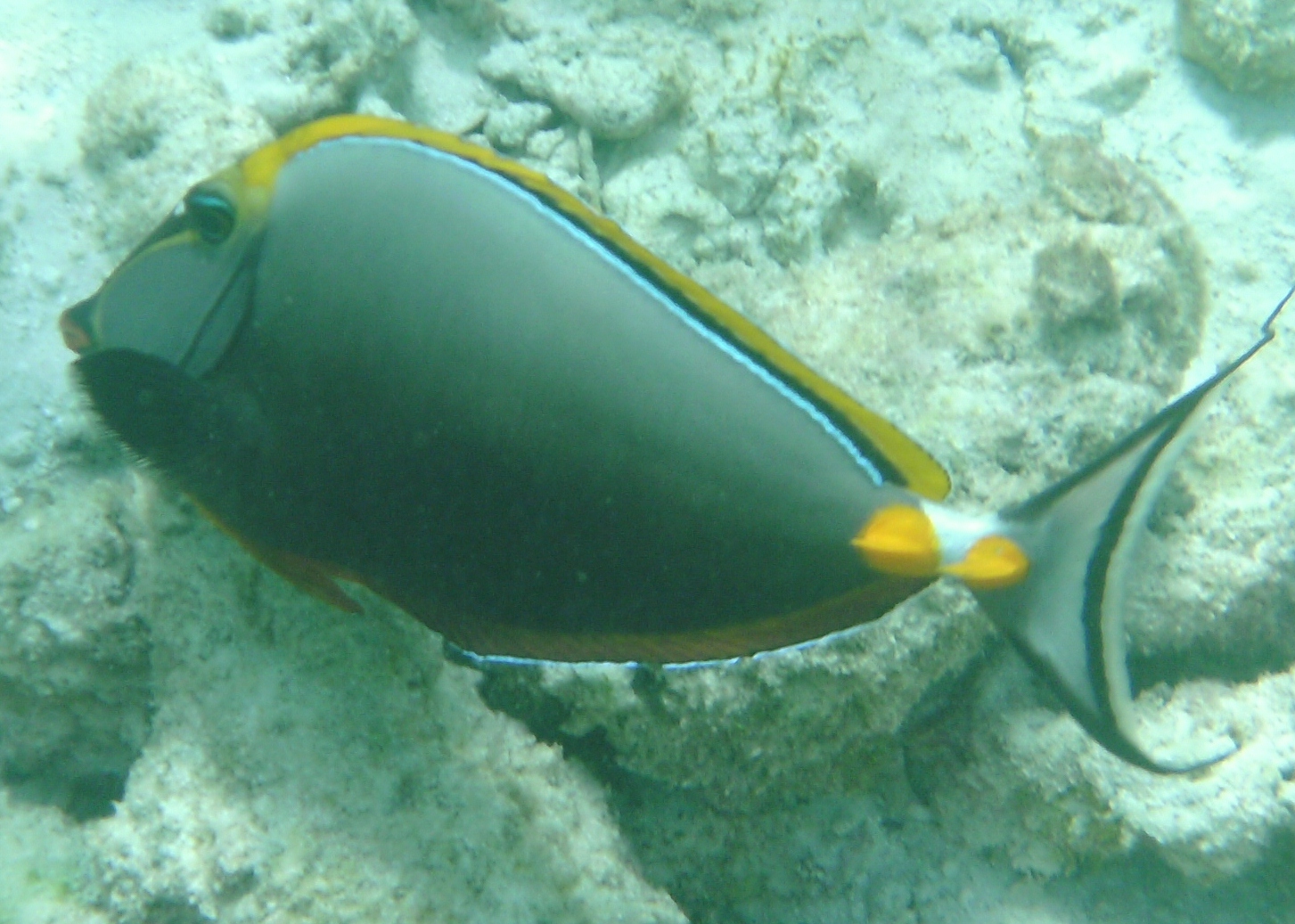
Unicornfish (Naso Lituratus): So called
because of the bright orange defensive spine scalpels on its tail,
the Orange-spine Unicornfish is seen often in the shallow inner
Lagoon and the Reef Crests. Just to confuse matters some fish books
call it the Yellowkeel Unicornfish. No matter. The thing to
remember is it's the one that looks like Elvis Presley with yellow
hair. It has a yellow-edged black mask extending from eyes to snout,
a mouth that looks like it has applied lipstick and a black and
yellow dorsal fin. A 45 cm grey body and a white tail edged in black
complete the ensemble.
Subscribe to:
Posts (Atom)